Efficiency of apple cider vinegar individually and in combination with selected antibiotics, and the potential impact of circadian rhythm on bacterial response to treatment in methicillin- resistant Staphylococcus aureus
Article Sidebar
Main Article Content
Abstract
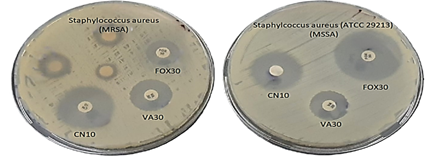
This study evaluated the antibacterial properties of apple cider vinegar (ACV) in two commercial forms, liquid and powder, against Methicillin-resistant Staphylococcus aureus (MRSA). The analysis employed the disk diffusion method, minimum inhibitory concentration (MIC), and minimum bactericidal concentration (MBC). Undiluted liquid ACV produced a 7 mm inhibition zone, while the powdered form exhibited inhibition zones of 7 mm, 10 mm, and 12 mm at dilutions of 1:5, 1:125, and 1:40, respectively. The MIC and MBC results were consistent for both forms, with the liquid form achieving MIC and MBC values of 6.25%, and the powdered form showing values of 15.63 mg/mL. Despite variations in geographic origin, the ACV samples demonstrated reproducible antibacterial efficacy. Combining ACV with cefoxitin (Fox30) and vancomycin (VA30) antibiotics, significantly enhanced antibacterial activity, particularly with Fox30, where the inhibition zone increased from 15.6 mm to 19.3 mm. However, combining gentamicin (CN10) with ACV at 500 mg/mL reduced the inhibition zone from 23 mm to 16 mm, indicating an antagonistic effect. Testing the effectiveness of Fox30, VA30, CN10, and neat liquid ACV at three different times of the day (spaced 8 hours apart) revealed no significant time-dependent changes. Slight variations in the powdered form’s efficacy warrant further investigation.
Article Details

This work is licensed under a Creative Commons Attribution 4.0 International License.