Targeting the hallmarks of aging: preclinical evidence and molecular mechanisms underlying the therapeutic potential of Centella asiatica (L.) Urban
Article Sidebar
Main Article Content
Abstract
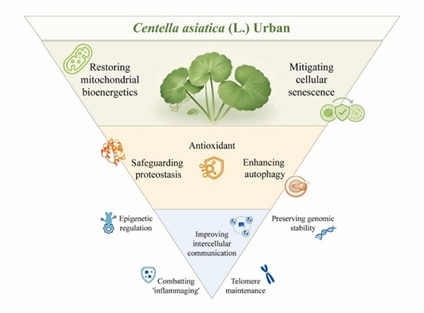
As the global demographic shifts toward an aging population, the escalating prevalence of age-related pathologies necessitates the identification of geroscience-based interventions. Centella asiatica (L.) Urban has emerged as a potent candidate for healthspan extension due to its dense concentration of bioactive pentacyclic triterpenoids, specifically asiaticoside, madecassoside, asiatic acid, and madecassic acid. This review synthesizes preclinical evidence demonstrating the capacity of C. asiatica to pharmacologically modulate the fundamental hallmarks of aging. At the molecular level, its constituents have been shown to maintain genomic stability by enhancing DNA repair mechanisms and mitigating epigenetic drift through the regulation of histone modifications. Furthermore, the plant exerts profound effects on mitochondrial bioenergetics, restoring mitochondrial homeostasis to counteract age-related metabolic decline. Analysis of in vitro and in vivo models reveals that C. asiatica suppresses the senescence-associated phenotype and systemic "inflammaging". We further detail the plant’s neuroprotective and tissue-regenerative properties, driven by the neutralization of reactive oxygen species (ROS) and the activation of antioxidant signaling. By systematically targeting these discrete cellular aging drivers, C. asiatica represents a potent, naturally-derived scaffold for the development of multi-target therapies aimed at extending biological healthspan. This review underscores the necessity of translating these preclinical mechanistic insights into targeted gerotherapeutic strategies.
Article Details

This work is licensed under a Creative Commons Attribution 4.0 International License.