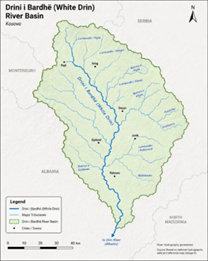
Ecological assessment of the Drini i Bardhë River basin based on biological quality elements (BQEs)
Article Sidebar
Main Article Content
Abstract
The ecological assessment of freshwater ecosystems represents an essential component of sustainable river basin management and environmental protection. This study evaluates the ecological condition of selected river sections within the Drini i Bardhë River basin, Kosovo, through the application of Biological Quality Elements (BQEs), including benthic macroinvertebrates, macrophytes, and fish fauna, supported by physico-chemical and hydromorphological parameters. Sampling was conducted at multiple sites representing different river types and varying degrees of anthropogenic influence. A total of 32 macroinvertebrate families, 57 macrophyte taxa, and several fish species characteristic of both mountain and lowland river habitats were identified. Macroinvertebrate-based indices, particularly BMWP and ASPT, revealed considerable spatial variation in ecological quality. Sites such as Burim–Istog, Drelaj, and Jasiq–Erenik showed relatively high biological quality and supported pollution-sensitive taxa, whereas several downstream and urban-influenced sites exhibited reduced diversity and lower ecological index values. Physico-chemical analyses indicated elevated concentrations of ammonium, nitrate, and phosphate at several locations, suggesting localized nutrient enrichment and wastewater influence. The ecological status classification demonstrated that only a limited number of investigated sites achieved Good ecological status, while most sites were classified as Moderate or Poor, and Lumi i Plavës was classified as Bad ecological status. The findings confirm the strong relationship between anthropogenic pressures and ecological degradation within the basin and demonstrate the effectiveness of Biological Quality Elements for river assessment in accordance with the principles of the European Water Framework Directive. The study contributes to the development of ecological monitoring approaches and provides scientific support for future river basin management, conservation strategies, and implementation of water protection policies in Kosovo.
Article Details

This work is licensed under a Creative Commons Attribution 4.0 International License.